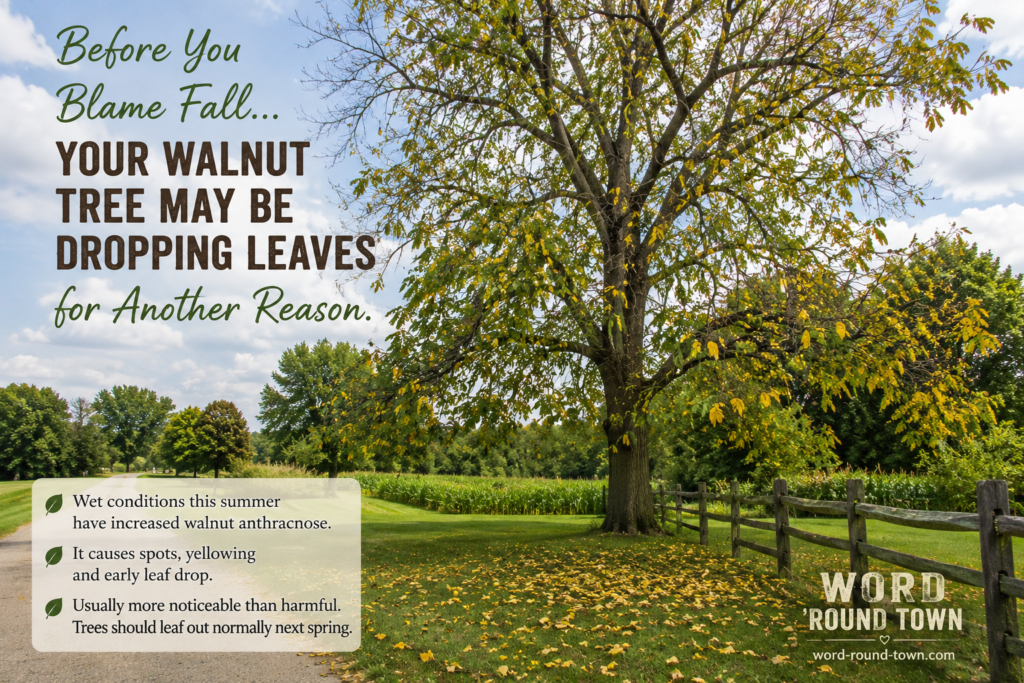
IOWA ~ If you’ve looked up at a black walnut tree lately and thought, “Well, that seems a little early…” you may not be imagining things.
Some black walnut trees across Iowa are turning yellow and dropping leaves sooner, and more heavily than usual this summer.
According to the Iowa Department of Natural Resources, the reason is likely walnut anthracnose, a common fungal leaf disease that has been showing up a little more than normal this year. Iowa’s prolonged wet conditions this growing season have created favorable conditions for new infections.
Walnut anthracnose can cause brown to black spots on leaves, followed by yellowing and early leaf drop.
By late summer, heavily affected black walnut trees can sometimes look surprisingly bare, with thin crowns or much of their foliage already gone.
That can certainly look alarming.
The good news?
According to the DNR, the early leaf loss is generally more noticeable than harmful.
By this point in the growing season, healthy trees have already completed much of their annual growth and stored much of the energy they need for next year. Treatment is generally not necessary, and healthy black walnut trees affected by the disease are expected to leaf out normally again next spring.
Walnuts aren’t the only Iowa trees that can develop anthracnose, either.
Different forms of the disease can also occur on oak, maple, sycamore, ash, linden and hickory trees, although the fungi responsible are generally specific to particular types of trees.
So if your walnut tree seems to be getting a head start on autumn, it may not mean fall has arrived early after all.
It might simply be carrying a little evidence of Iowa’s very wet summer.
And sometimes, what looks like a tree giving up for the year is really just nature responding to the weather it was given.
Worth Knowin’ ’Round Town
Deliverance Hope
Keep Goin’ ‘Round Town
There’s always another story waiting just around the corner.