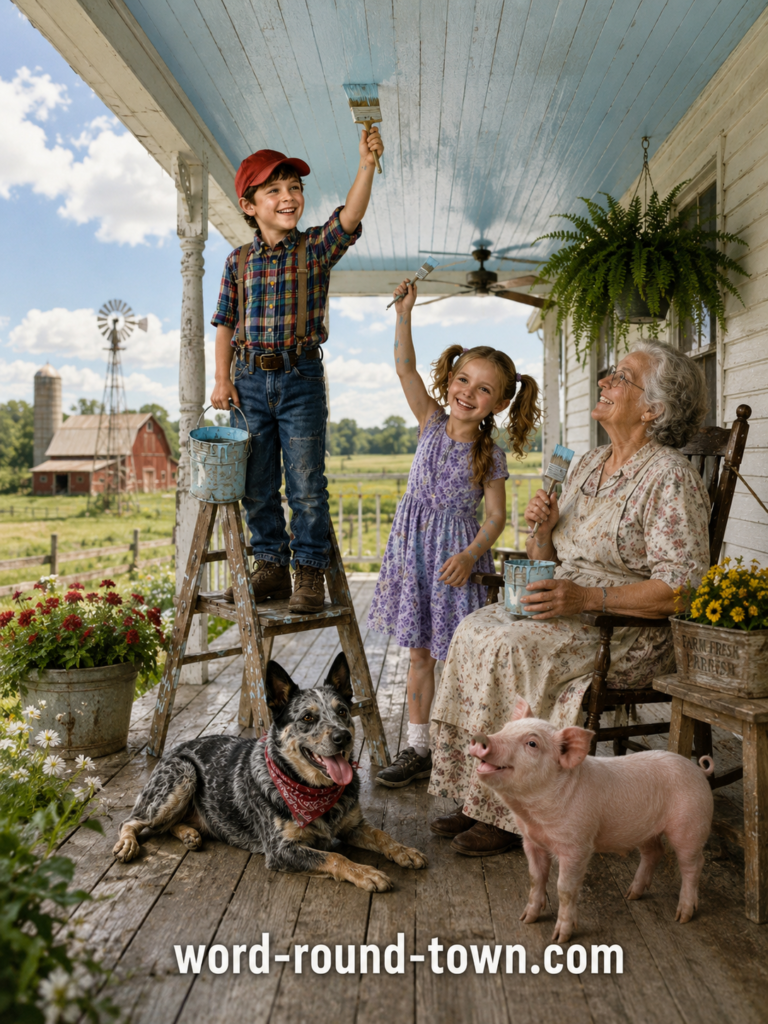
There is something especially inviting about an old porch.
A rocking chair.
A breeze moving through the trees.
Maybe the creak of a floorboard underfoot.
And if you happen to look up, you may notice something else:
A ceiling painted a soft, pale blue.
Pretty?
Absolutely.
But in many parts of the South, that color carries a story much older than simple decorating taste.
The shade is often called haint blue, and its history is closely tied to the Gullah Geechee people of the coastal Southeast, especially in areas of South Carolina and Georgia. The word “haint” is a variation of “haunt” and traditionally referred to troublesome or restless spirits.
According to folklore, painting porch ceilings, doors, shutters and other parts of the home in pale blue-green shades was believed to help keep those spirits away.
Why blue?
One explanation is that the color was thought to resemble the sky.
Another is that it represented water, which some traditions held spirits could not cross.
Whether every household believed the same thing is impossible to say, but over time, the practice became part of the visual character of many Southern homes.
And the color stayed.
Long after the original beliefs faded for some families, the blue ceilings remained.
Sometimes because a grandmother had always painted hers that way.
Sometimes because a house simply didn’t look right without it.
And sometimes because traditions have a way of continuing even after people forget exactly how they began.
There is also another story often told about blue porch ceilings.
For generations, some homeowners have claimed the color helps discourage wasps, spiders and other insects from building nests overhead.
You may have even heard that insects mistake the blue for open sky.
It is a charming explanation.
But that part of the story should be treated as folklore rather than settled science.
There does not appear to be strong evidence that blue paint by itself reliably keeps wasps away. Some historians have suggested that older paints may have contained ingredients such as lime that could have made painted surfaces less attractive to insects, which may have helped the reputation stick.
So perhaps the blue ceiling did help in some homes.
Just maybe not for the reason people thought.
And that somehow makes the story even better.
Because haint blue is not simply a paint color.
It is a mixture of memory, belief, practicality, tradition and place.
It is a reminder that the things we see every day, a porch ceiling, a shutter, a painted door, can carry stories we might never notice unless we stop long enough to ask:
Why is that there?
Today, many people choose pale blue porch ceilings simply because they love the way the color feels.
Cool.
Calm.
Open.
Almost like bringing a little bit of sky beneath the roof.
But behind that peaceful color is a tradition with deep Southern roots and a story passed from one generation to another.
So the next time you find yourself sitting beneath a blue porch ceiling, look up.
You may be seeing more than paint.
You may be seeing a little piece of history still hanging overhead.
Worth Knowin’
Haint blue is not one single official paint shade. The term generally refers to a range of pale blue-green colors traditionally used on porches, doors and shutters in parts of the South.
Sources include historical and cultural information on Gullah Geechee traditions and haint blue, along with modern discussions of the insect-repellent claim.
Keep Goin’ ‘Round Town
There’s always another story waiting just around the corner.