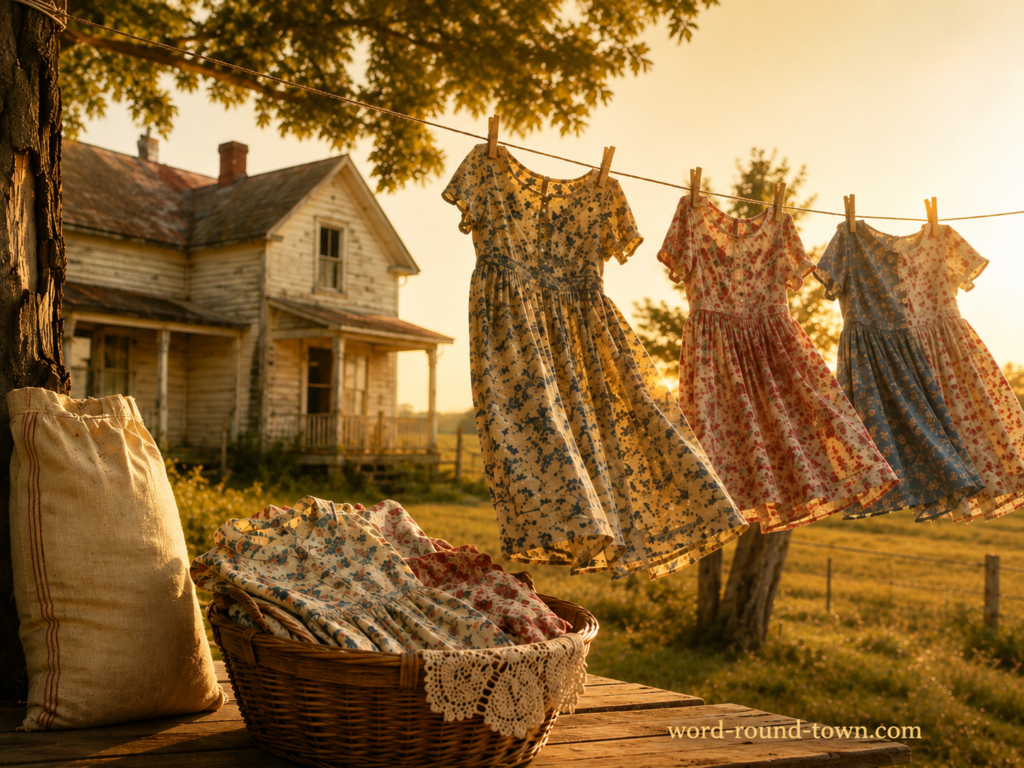
There was a time when a little girl might twirl across an Iowa farmhouse kitchen in a brand-new dress, holding the skirt out with both hands and feeling as pretty as any child ever could.
She may not have known that dress had once been a flour sack.
She may not have known her mother had saved the sack carefully, washed it, pulled the stitching loose, pressed every wrinkle flat and laid the cloth across the kitchen table to study it.
She may not have known Mama turned it this way and that, searching for the prettiest place to cut.
Or that she worked around stains, seams and worn spots because there was no sense wasting a piece that could still become something useful.
The little girl only knew one thing.
Mama had made her a new dress.
And perhaps Mama never told her anything more.
Perhaps she simply buttoned the back, straightened the collar, smoothed the skirt and said,
“Well, look at you.”
Because children did not always need to know what something had cost.
Sometimes a mother wanted them only to know what it had become.
During lean years, nothing went to waste.
Not because families were trying to be charming or old-fashioned.
Sometimes there simply was not money to replace what could still be used.
A flour sack was cloth.
And cloth was valuable.
In capable hands, it might become a dress for Sunday morning.
An apron tied around Mama’s waist.
Curtains moving softly in an open window.
A dish towel beside the sink.
A patch over the knee of a pair of britches.
Or little squares tucked away until there were enough to make a quilt.
That may be why so many grandmothers could never bring themselves to throw away a good piece of fabric.
Buttons went into coffee tins.
Ribbon was rolled and saved.
Scraps were folded into drawers.
Clothes were mended, handed down, altered and mended once again.
They knew something many of us have forgotten.
A thing did not have to be new to still have worth.
And being worn did not mean being finished.
There was love in those stitches.
Patience in those hems.
Hope folded into every piece of cloth that was saved because somebody could already imagine what it might become.
Years later, that little girl may not have remembered the flour company printed on the sack.
She may not have remembered the kitchen table where the pattern was cut.
But perhaps she remembered how that dress moved when she spun around.
Perhaps she remembered Mama watching from across the room.
And perhaps she remembered feeling beautiful.
That is the part worth holding onto.
Because somewhere along the way, an ordinary sack stopped being something that carried flour.
It carried a child to church.
It carried her through a summer afternoon.
It carried the work of a mother’s hands.
And long after the dress wore thin and the last scraps found their way into a quilt, it carried something even farther.
A memory.
Nothing went to waste.
Not the cloth.
Not the stitches.
Not the love.
And maybe that is why, all these years later, those old feed-sack dresses still have something to teach us:
In hands filled with love, even the humblest thing can be given another life.
And sometimes the most beautiful things a mother ever gives her child are the things that child never knew she had to sacrifice to make.
Keep Goin’ ‘Round Town
There’s always another story waiting just around the corner.