There are some things happening all around us that are easy to miss if we don’t know to look for them.
A bird tucked beneath the leaves.
A deer standing quietly at the edge of a field.
A butterfly drifting across the road.
But this time of year, if you happen to glance toward the right tree at just the right time…
you might discover that one butterfly isn’t alone at all.
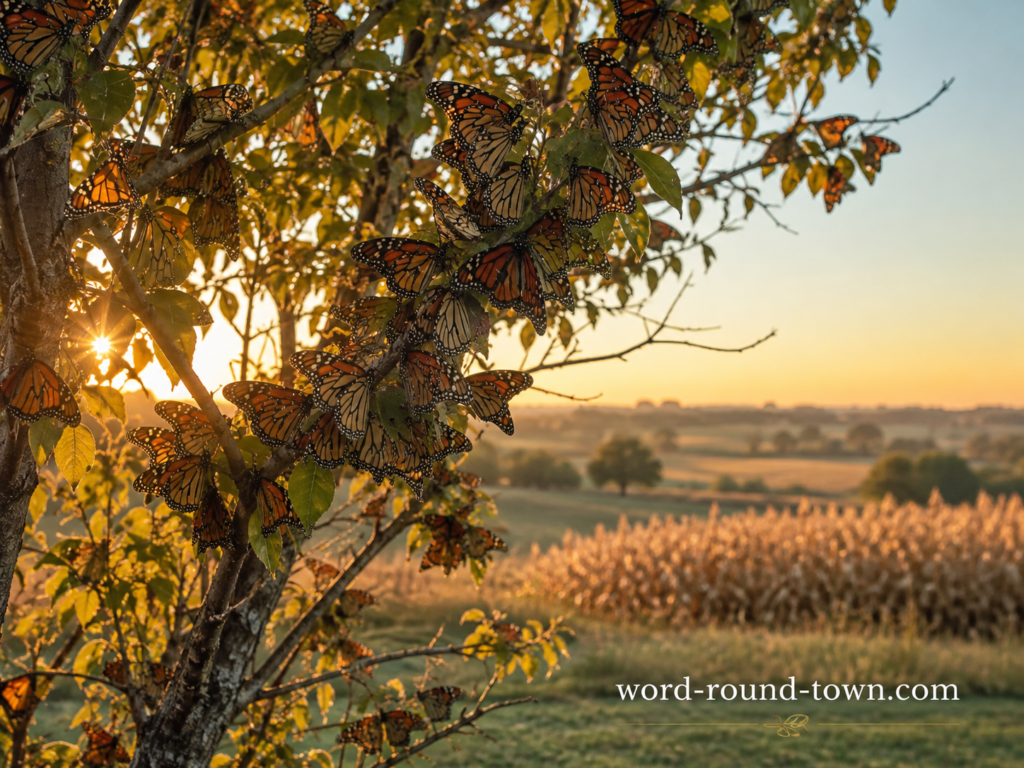
There could be dozens ~ even hundreds ~ of monarch butterflies gathered together for the night.
And Iowa researchers would really like to know if you find them.
The Iowa Monarch Conservation Consortium is asking landowners and community members across the state to report places where monarch butterflies are gathering in clusters as they make their fall migration south toward Mexico.
These temporary resting places are called monarch roosts.
And there may be one much closer to home than you realize.
A Little Butterfly Bed & Breakfast
Monarchs don’t necessarily travel south in one big group like geese flying overhead.
During the day, they generally make their journey individually.
But when evening comes?
They may gather together in trees and other sheltered places to spend the night.
Some roosts contain only a handful of monarchs.
Others can contain hundreds ~ or even thousands.
They may stay for only a night or two before continuing their journey, although some locations can host monarchs longer. Journey North has been collecting reports of these nighttime gatherings for nearly three decades, helping researchers follow the progression of the fall migration.
So while we are tucked into our own beds at night…
somewhere out there, an entire tree may be quietly filling up with butterflies.
There’s something awfully beautiful about that. ❤️
So… What Should You Look For?
According to the Iowa Monarch Conservation Consortium, a monarch roost may look like dozens to hundreds of monarchs clustered together on tree branches.
They are often found in protected places such as woodland edges, windbreaks and river corridors, and roosting is most noticeable in the evening and early morning.
In other words…
before you walk past that tree tomorrow morning thinking it’s just another tree…
look twice.
You might have overnight guests.
And They’ve Got Quite a Trip Ahead of Them
These little travelers aren’t simply moving over to the next county.
Monarchs from our part of North America make an extraordinary fall migration south toward their overwintering grounds in Mexico.
Iowa sits along an important migration corridor, which is one reason researchers want to know where monarchs are stopping to rest along the way.
By identifying those locations, scientists can learn more about which habitats monarchs are actually using during migration and which places may be especially important to protect or restore.
That’s where ordinary Iowans come in.
You don’t need a biology degree.
You don’t need a research lab.
You don’t even need to know the scientific name of the tree.
Sometimes…
you just need to notice.
Found a Roost? Here’s What Iowa Researchers Want to Know
If you see monarchs roosting on your property ~ or spot a roost on public land ~ the Iowa Monarch Conservation Consortium is asking people to report it.
Helpful information includes:
- The general location
- The type of tree, if known
- Approximately how many monarchs you saw
- The date or dates they were there
- Photographs, if you can safely take them
Reports can be emailed to monarchs@iastate.edu, and the consortium says reported data will remain anonymous. Sightings can also be submitted through Journey North, which maintains maps of monarch fall roost reports.
And don’t worry if your roost isn’t enormous.
Journey North encourages reports whether there are five monarchs or 5,000.
And Apparently Butterflies Have Gone High-Tech
Here’s one I certainly didn’t expect.
This fall, researchers are also using tiny solar~powered Bluetooth tags to help study monarch migration.
The Iowa Monarch Conservation Consortium plans to release tagged monarchs in September as part of a migration research project. People can download the Project Monarch app, turn on Bluetooth and potentially help researchers locate tagged butterflies traveling through their area.
Yep.
Apparently even the butterflies have Bluetooth now.
Meanwhile, some of us are still trying to figure out why the printer says it’s offline when it’s sitting three feet away. 😂
❤️ Sometimes Helping Starts With Simply Looking
We spend an awful lot of our lives looking ahead.
At the road.
At the clock.
At where we have to be next.
And maybe that’s why I love stories like this one.
Because for once, helping doesn’t necessarily require us to go somewhere special.
It asks us to look at what’s already here.
At the trees beside our homes.
At the edges of our fields.
At the parks and river bottoms we pass every day.
And maybe one evening, if we’re lucky, we’ll notice a flutter of orange settling among the leaves.
Then another.
And another.
Until suddenly we realize…
the travelers have stopped here for the night.
So over the next several weeks, Northeast Iowa…
keep your eyes on the trees.
Because somewhere out there, hundreds of tiny orange-and-black wings may be settling down together before sunrise sends them on another leg of a journey that will eventually carry them all the way to Mexico.
And if you happen to discover where they’re sleeping?
Psst… Iowa wants to know. ❤️
Word ’Round Town
Northeast Iowa Community Living
Come on… let’s go ’round town. ❤️
Keep Goin’ ‘Round Town
There’s always another story waiting just around the corner.