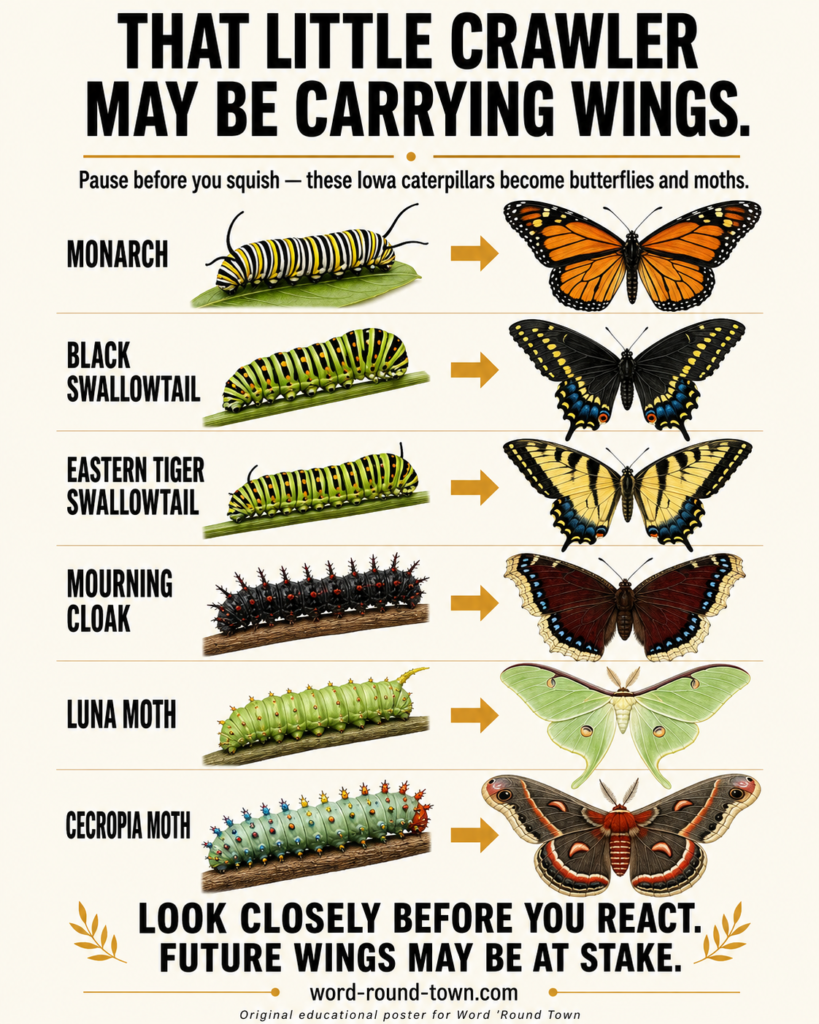
Before brushing away the caterpillar on the dill, tree branch, or garden path, take another look. Some of Iowa’s most beautiful butterflies and moths begin life looking nothing like the wings they will someday carry.
By Deliverance Hope | Word ’Round Town
There it is.
Crawling across the sidewalk.
Chewing on the dill.
Hanging from a leaf.
Stretching its little body across a branch as though it has somewhere terribly important to be.
And perhaps it does.
Our first instinct when we see a caterpillar may be to brush it away, move it along, or, depending on where we find it, declare war on whatever has been nibbling holes into the garden.
But sometimes that funny little crawler is carrying something we cannot yet see.
Wings.
Across Iowa, caterpillars that may look striped, spiny, green, fuzzy, enormous or downright peculiar eventually become some of the butterflies and moths that make us stop in our tracks.
The Iowa Department of Natural Resources reports that approximately 110 species of butterflies reproduce in Iowa, while Iowa State University also documents some spectacular native moths found here.
And several of them begin with caterpillars you might encounter surprisingly close to home.
The Monarch
Perhaps Iowa’s most recognizable butterfly begins as a caterpillar striped in black, yellow and white.
Monarch caterpillars depend upon milkweed, where they feed before forming a chrysalis and undergoing the remarkable transformation that produces those familiar orange-and-black wings.
Iowa’s monarchs are part of the eastern population known for its extraordinary fall migration toward central Mexico, a journey that can span thousands of miles.
Think about that for a moment.
The little striped creature eating a milkweed leaf beside an Iowa road may someday take to the sky on a journey farther than many of us will travel all year.
The Black Swallowtail
Gardeners who grow dill or parsley may have already met this one.
The black swallowtail caterpillar is commonly associated with plants in the carrot family, including dill and parsley. Iowa State University notes that black swallowtails found feeding on dill may overwinter in the chrysalis stage before completing their transformation the following spring.
What begins as a plump green caterpillar decorated with dark bands eventually becomes a dramatic dark-winged butterfly accented with yellow, blue and touches of orange.
So if something appears to be helping itself to the herb garden…
you may have a future butterfly dining at the salad bar.
The Eastern Tiger Swallowtail
The Eastern Tiger Swallowtail is another butterfly found in Iowa.
Its yellow wings marked with bold black “tiger” stripes make it difficult to overlook once it takes flight.
Its caterpillars use woody plants and trees as hosts; Iowa State University lists trees including willow and birch among plants that support Eastern Tiger Swallowtails.
The caterpillar itself can be remarkably good at disappearing into foliage, green, smooth-bodied and far less flashy than the butterfly it will eventually become.
The Mourning Cloak
This may be one of the best examples of why appearances can fool us.
The Mourning Cloak caterpillar, sometimes called the spiny elm caterpillar~ is dark, covered with spines and marked with reddish spots.
It does not exactly scream, Someday I shall be elegant.
Yet it becomes a beautiful dark-maroon butterfly edged in pale cream with a row of blue markings.
Iowa State University describes the caterpillar as moderately common in Iowa and notes that it feeds on trees including elm, willow, birch, cottonwood and hackberry.
The adult Mourning Cloak has another unusual distinction: unlike many butterflies, it can survive Iowa winters as an adult by sheltering in protected places.
The Luna Moth
And then there are creatures that almost do not look real.
The Luna Moth is one of them.
Its caterpillar is large and green, but the adult moth that eventually emerges is pale green with sweeping tails extending from its hind wings.
Iowa State University includes the Luna among Iowa’s giant silkworm moths and describes it as one of the less commonly encountered members of that remarkable group.
Seeing one resting beneath a porch light or among vegetation can feel less like finding an insect and more like stumbling across something borrowed from a storybook.
The Cecropia Moth
The Cecropia caterpillar may win the award for looking as though someone decorated it for a parade.
Large, bluish-green and covered with colorful knobs, it is difficult to mistake for an ordinary little garden crawler.
Eventually it becomes the striking Cecropia moth, one of the giant silk moths found in Iowa. Iowa State University identifies the Cecropia, Polyphemus and Luna among the state’s notable large moths.
Its transformation is another reminder that nature rarely reveals the ending at the beginning.
Not Every Caterpillar Needs Our Hands
Of course, protecting wildlife does not mean picking up every caterpillar we encounter.
Some caterpillars have hairs or spines that can irritate human skin, and an unidentified caterpillar is usually better observed than handled.
If one appears to be in immediate danger, identification first is a good idea. Otherwise, sometimes the kindest thing we can do is simply allow it to continue doing what caterpillars have been doing long before we arrived:
eating.
growing.
changing.
waiting.
Because We Rarely Know What Something Is Becoming
Perhaps that is what makes the caterpillar such a beautiful little reminder.
We tend to judge things by what they look like right now.
Awkward.
Unfinished.
Slow.
Maybe even a nuisance.
But nature has never been particularly concerned with first impressions.
The caterpillar does not resemble the butterfly.
The chrysalis does not look like flight.
And yet somewhere inside that quiet transformation, wings are forming.
So the next time a strange little crawler appears beneath your feet, on the garden fence, or halfway through your parsley…
take another look before reacting.
It may simply be passing through one stage of a much bigger story.
That little crawler may be carrying wings.
And sometimes the most beautiful things around us begin in forms we never would have guessed.
~Deliverance Hope
Word ’Round Town
word-round-town.com
Keep Goin’ ‘Round Town
There’s always another story waiting just around the corner.